

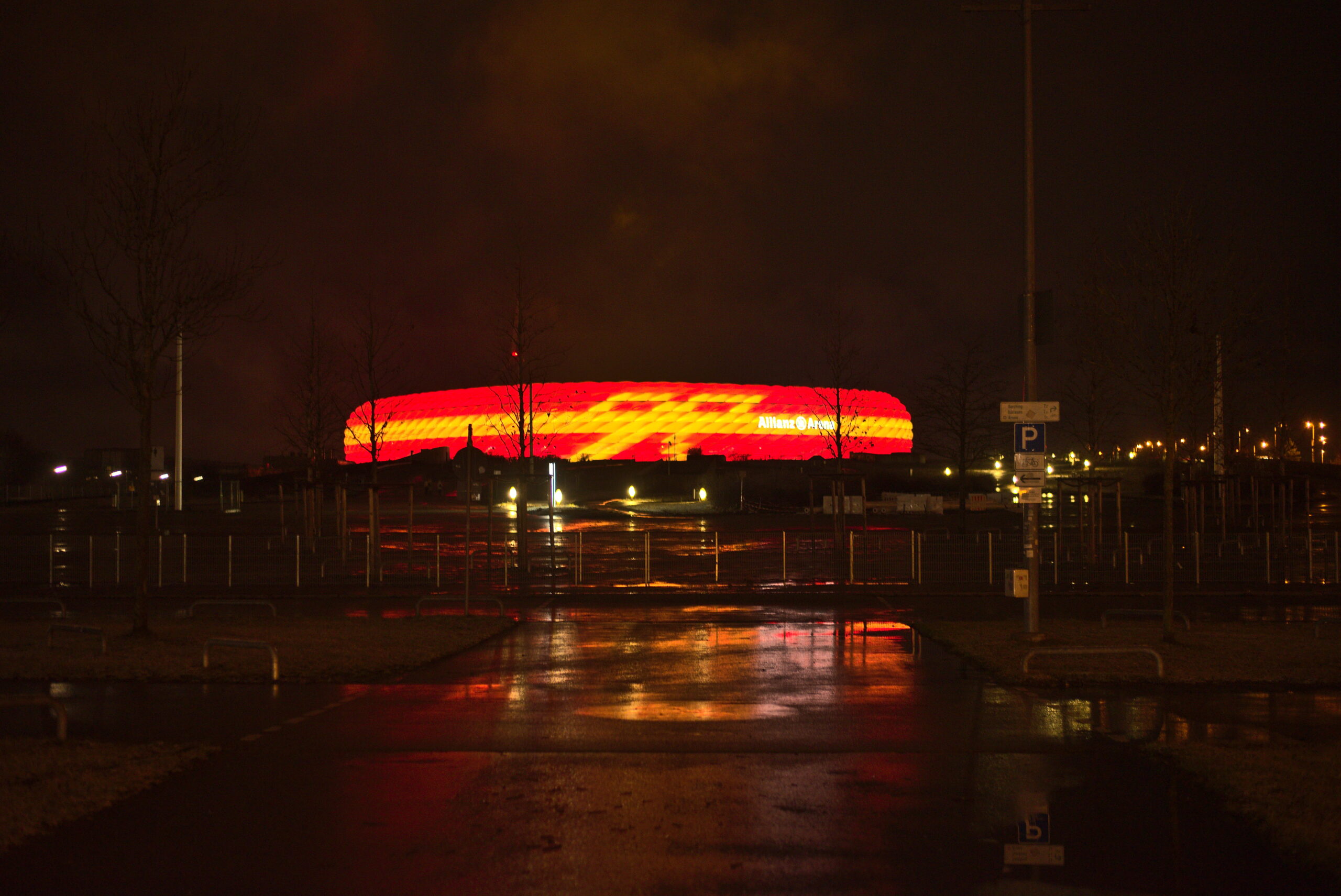
Allianz Arena stadium in Munich is one of the most impressive and advanced football stadiums in the world, with a capacity of 75,000 seats for domestic matches and 70,000 for international matches. The stadium was the first in the world with an exterior cladding that changes color — more than 300,000 LED lights that can display 16 million different colors — and since it opened in 2005 it has become one of the most prominent architectural symbols of Munich and of German football as a whole. If you're planning to fly from Israel to Munich to watch Bayern Munich in the Bundesliga, the Champions League, or the German Cup — this comprehensive guide will prepare you for the perfect experience, from booking tickets to the moment you get back to your hotel after the final whistle.
Basic facts — Allianz Arena by the numbers
- Capacity: 75,000 seats (Bundesliga, including standing areas), 70,000 for international matches (seating only, including UEFA)
- Opened: 30 May 2005, officially inaugurated with the 2006 Germany World Cup
- Construction cost: €340 million (completed on budget and on time — a rare achievement for a project of this scale)
- Location: Werner-Heisenberg-Allee 25, Fröttmaning, north Munich
- Official name: Allianz Arena (sponsorship by Allianz SE from 2005, a €110 million deal for 30 years)
- Ownership: FC Bayern München AG (100% since 2006, after TSV 1860 Munich failed to keep up payments and exited the partnership)
- Architects: Herzog & de Meuron (the same architects who designed the "Bird's Nest" at the 2008 Beijing Olympics)
- Signature feature: 2,874 illuminated ETFE panels — the first stadium in the world with color-changing cladding
- Lighting: 300,000+ LED lights, 16 million possible colors (upgraded in 2016)
- Facilities: Museum Bayern Munich (FC Bayern Museum), official store (Megastore), 106 VIP boxes, 1,374 business seats
When the stadium opened in 2005, it completely changed the rules of the game in modern stadium design. The exterior cladding is made of transparent, air-inflated ETFE (Ethylene Tetrafluoroethylene) plastic — a light, durable, and partly transparent material — which creates the famous look of a giant glowing cushion that seems to float in the air. During Bayern Munich matches, the stadium lights up intense red. In the days of TSV 1860 Munich, which shared the stadium with Bayern until 2017, it was blue. During Germany national team matches it's white. Since the LED lighting upgrade in 2016, the stadium can display 16 million colors and complex patterns — including logos, national flags, holiday graphics, and animations for special events. On Pride Day it's lit in rainbow colors, on Holocaust Remembrance Day in festive white, and at Christmas in green and red.
The stadium was designed by the Swiss architecture firm Herzog & de Meuron, winners of the Pritzker Prize ("the Nobel of architecture") in 2001. The same firm also designed the "Bird's Nest" stadium in Beijing and the Tate Modern in London. The Allianz Arena's design draws inspiration from an organic shape — some visitors call it "the rubber tire" or "the rubber dinghy" because of its puffed-up, rounded form.
Seating map — where's the best place to sit at Allianz Arena?
Allianz Arena is divided into three main levels (tiers), and each one has a completely different character in terms of the viewing experience, atmosphere, and price. A deep understanding of the stadium's structure will help you choose the right ticket and get the most out of the experience.
The lower tier (Unterrang) — closest to the pitch, the most expensive
The lower tier is the level closest to the pitch and provides the greatest intimacy with the action. It's also the most expensive level in the stadium — here you'll find the Category 1 seats, priced on the secondary market between €400 and €721 for big Champions League matches. Central blocks along the pitch's halfway line (roughly rows 1–25) are considered the clear premium locations. The viewing angle is excellent and the sense of closeness to the players is immense — you can hear the players shouting to each other, see their expressions.
That said, note: in the very low rows (1–5) you're right at grass level, which is great for the feel but makes it harder to follow tactical movement and the wider game. If you prefer to see the whole picture — rows 15–25 in the lower tier offer the perfect balance between closeness and a comprehensive view. This level also includes the 106 private boxes and the 1,374 business seats, which come with private catering, lounge access, and full VIP service.
Südkurve — the standing terraces, the heart of the fans and the soul of the stadium
The Südkurve (the south curve) is the beating, roaring heart of Allianz Arena. This is where Bayern Munich's ultras gather — the Schickeria München group is the dominant one, leading the chants, the giant choreographies, the tifo displays (colored paper thrown into the air), and the waving of flags and banners throughout all 90 minutes and beyond. The Südkurve holds 14,000 standing places (in the Bundesliga) and is without a doubt the most intense, loudest and most passionate experience in the stadium.
These standing places aren't for everyone — you'll stand on your feet for 90+ minutes, jump, get splashed with beer spilling from every direction, shout until you lose your voice. It's an authentic German experience unlike any other stadium in Europe, but if you're looking for a quieter, more comfortable experience, with a seat and the ability to sit quietly — the Südkurve isn't for you. If you do want that kind of experience — it's the most authentic thing you'll find in German football.
In the Südkurve prices are the lowest in the stadium — secondary-market availability starts at around €169 for regular Bundesliga matches and can reach €300+ for big matches. On the other side of the pitch, the Nordkurve (the north curve) is usually reserved for away fans, and the atmosphere there is completely different.
The upper tier (Oberrang) — panorama, excellent value, and a tactical view
The upper level offers a stunning panoramic view of the entire pitch from end to end. Although you're physically farther from the grass, the big advantage is total visibility of all the tactical action — you see the formations, the off-the-ball movement, and the wide game in a way you can't from the lower tier. Many tactically minded football fans prefer this level. Prices here are significantly lower than the lower tier — roughly €200–€400 on the secondary market, which offers excellent value for your money. In addition, the upper tier is fully covered, so even if it rains — you stay dry.
Ticket prices — what to expect when buying a ticket to a Bayern match
- Average price (official price list): €111 per Bundesliga ticket
- Secondary market — regular Bundesliga: €169–€450, depending on the opponent and location
- Secondary market — derby (Borussia Dortmund): €350–€600+
- Secondary market — Champions League (knockout stage): €400–€721+
- Südkurve (standing): starting at €169 on the secondary market
- VIP / Business Seats / Loge: €500–€1,200+ depending on the event
A very important tip: ticket prices rise significantly the closer you get to the match date, especially for high-demand matches. If you already know you want to see Bayern Munich against Borussia Dortmund, Real Madrid, Barcelona, or any Champions League match — book as early as possible, even weeks in advance. Booking early can save you tens of percent off the price.
How to get to Allianz Arena from Israel? The full route
Direct flights from Ben Gurion to Munich
El Al (ELAL) operates a direct flight from Ben Gurion to Munich Airport (code: MUC) — flight time about 4.5 to 5 hours. Munich is one of the most convenient destinations in Europe for Israeli football fans thanks to the relatively short direct flight. In addition to El Al, Lufthansa (direct), Wizz Air (sometimes with a stopover), and Eurowings also fly to Munich. Round-trip flight prices range between $200 and $450 depending on the season and booking date — the earlier you book, the lower the price.
Munich Airport (Franz Josef Strauss International Airport) is the second-largest in Germany, located about 35 km northeast of the city center. The airport is modern, convenient, and well organized — you won't have trouble finding your way. From the airport to central Munich you travel by S-Bahn (lines S1 or S8) — about a 40-minute ride, a single ticket costs about €13.
From the airport straight to the stadium — if time is short
Note an important detail: Allianz Arena is located in north Munich, closer to the airport than to the city center. If you land on matchday and time is tight, a direct taxi from the airport to Allianz Arena takes only about 20–25 minutes and costs €40–€50. This is an excellent option if your flight lands late and you want to get straight to the match. With Uber or Bolt, the price can be 20%–30% lower.
Subway (U-Bahn) — the best and cheapest way from the city
Line U6 to Fröttmaning station — 16 minutes from Marienplatz (Munich's central square). Fröttmaning station is right next to the stadium, about a comfortable 10-minute walk from the main entrance. On matchday, U6 trains depart every 3–5 minutes, with extra cars added to the line. A single ticket costs about €3.50.
Money-saving tip: A day ticket (Tageskarte) costs €8.80 and covers unlimited travel across all of Munich for a full day — this is very worthwhile if you're planning to move around the city before and after the match, go out to eat, tour Marienplatz, or visit the English Garden.
Tip for leaving: After the match, Fröttmaning station gets extremely crowded. 75,000 fans try to board the train at the same time. If you're not in a hurry — wait 20–30 minutes near the stadium, buy another beer, let the crowd thin out, and then board a relatively empty train. In the end this saves you both nerves and time.
Private car or rental
Allianz Arena is very conveniently accessible from the A9 highway (from the north, including from the airport) and the A99 (Munich's ring road, from any direction). The infrastructure around the stadium was planned in advance for heavy traffic, with wide access roads and clear signage.
The stadium offers 9,800 parking spaces in two covered underground parking lots, priced at €12–€15 per matchday. The lots open about 3 hours before kickoff. It's highly recommended to arrive early — on a big matchday, especially in the Champions League, all 9,800 spots fill up very quickly and then there's no nearby alternative.
Important to know: in Germany, disciplined driving that strictly follows the rules is an absolute norm. There are no toll roads on the way to the stadium (unlike France or Italy). If you rent a car — make sure the insurance includes full coverage (CDW + Theft Protection + Liability). Some roads in Munich require an environmental sticker (Umweltplakette) — make sure your rental car comes with one.
Recommended hotels near Allianz Arena and in Munich
Munich offers a very wide range of lodging options, from five-star luxury hotels to youth hostels and Airbnb. Here are our recommendations by price range, with an emphasis on accessibility to the stadium:
Arena Stadt München — closest to the stadium
€120–€180 a night | A few minutes by car from Allianz Arena. A modern hotel built specifically for guests attending matches and events at the stadium. Clean, comfortable and spacious rooms, private parking available, good breakfast. An ideal location for anyone who wants to focus on the match without the hassle of public transport after a night match. The downside — the area itself is quiet and doesn't have much nightlife or many restaurants.
Ameron München Motorworld — design, character and experience
€100–€150 a night | A unique boutique hotel themed around classic cars, located in south Munich inside the Motorworld complex, which includes a car exhibition, restaurants, and shops. Industrial-elegant design, an excellent restaurant on site, and convenient public transport to the stadium (S-Bahn + U-Bahn, about 30 minutes total). A unique experience for sports fans who also want culture and atmosphere — especially if you're coming with a partner who isn't necessarily a football fan.
ibis München City Nord / Garching — an excellent middle ground
€70–€110 a night | The ibis chain is known for consistent, reliable quality and fair prices with no surprises. The Garching branch is on the U6 line — the exact same line that goes directly to Fröttmaning station and the stadium. That means you get on the train and you're at the stadium within a few minutes. Clean, simple, and practical rooms. Breakfast available for an extra charge.
B&B Hotels München — the budget option
€60–€90 a night | If the match is the main thing and the hotel is just a place to sleep and shower — B&B Hotels offers basic, clean and well-maintained rooms at the lowest price you'll find at a legitimate hotel chain in Munich. Several branches are spread across the city, all near public transport stations. Free WiFi, paid parking.
Important warning: In Munich, the Oktoberfest period (usually late September to early October, about two weeks) doubles and triples hotel prices across the entire city. If there's a Bayern match during that period — book months in advance, otherwise you'll find yourself paying €250 for a room that usually costs €80, or worse — no room at all.
Food and drink — inside the stadium and around it
Inside Allianz Arena — an authentic Bavarian experience
The food experience at Allianz Arena is Bavarian to the core, and it's one of the most distinctive things compared to stadiums in England, Spain, or Italy. Here they don't sell microwaved pizza — here they serve real Bavarian dishes that Germans themselves eat.
- Bavarian sausages (Bratwurst): The German classic that no match goes without. A grilled sausage in a fresh roll with Bavarian mustard (süßer Senf — a sweetish mustard completely different from yellow mustard). €5–€7 per sausage. This is what most fans eat, and it's tasty and filling.
- Pretzel (Brezel): The giant Bavarian pretzel with coarse salt — €4–€5. Big, soft inside, crispy outside. Perfect as a snack with beer. Like a New York bagel, only German and better.
- Cheese spätzle (Käsespätzle): Homemade German pasta (spätzle) with melted Emmental cheese and onions fried until golden — €8–€11. This is the perfect Bavarian comfort food, like German mac and cheese on a whole different level. Highly recommended if you want a real meal and not just a snack.
- Beer — Paulaner: Paulaner is the official beer of Bayern Munich and of Allianz Arena. €5–€7 for half a liter. An important point: Germany is the only country among Europe's big leagues where beer is served inside the stadiums and drinking in the stands is allowed. Yes, you can sit with a beer in hand and watch the match. It's an experience.
- Leberkäse-Semmel: A warm slice of baked meatloaf-like meat in a fresh roll with mustard — €5–€6. Very popular, quick, and filling. The unofficial lunch of every German fan.
- Schmalzbrot: Dark bread with rendered goose fat and onion — €3–€4. A traditional dish you won't find at any other stadium in Europe.
Outside the stadium — restaurants in the area and central Munich
The immediate area around Allianz Arena is suburban-industrial with no large concentration of restaurants. That said, south of the stadium you'll find a traditional Bavarian restaurant — Wirtshaus am Fröttmaninger Berg — which serves high-quality traditional Bavarian food: a giant schnitzel (Wiener Schnitzel), roasted pork knuckle (Schweinshaxe), potato dumplings (Kartoffelknödel), Bavarian potato salad, and locally brewed draft beers. It's recommended to book a table in advance on matchday since the place fills up fast.
An excellent and recommended alternative: head down to central Munich (Marienplatz — 16 minutes on the U6, remember?) and eat there before or after the match. The Viktualienmarkt market (a minute's walk from Marienplatz) offers an enormous variety of fresh food — sausages, cheeses, breads, pastries, and beers of every kind. Hofbräuhaus, the most famous beer hall in the world (since 1589), is a 5-minute walk from Marienplatz — a classic Bavarian experience with a live band, liters of beer, and sausages.
Kosher food in Munich — options for the kosher-observant
Café Bracha — an Israeli-owned Israeli café on Klenzestraße 47, in the Glockenbachviertel neighborhood (Munich's young and lively area). They serve shakshuka, hummus, Israeli salads, pastries, Israeli coffee and cakes. The atmosphere is entirely Israeli, and the staff speaks Hebrew. Important note: the café does not hold an official kosher certificate from a rabbinate or a beit din, but the owners are Israeli and they offer many vegan and vegetarian options. About 25 minutes by U-Bahn from the stadium.
For those who strictly keep supervised kashrut — Munich isn't known as a city with many kosher restaurants, unlike London or Paris. It's highly recommended to bring packaged food from home, cook in an Airbnb apartment with a kitchen (you can find kosher products at Edeka or REWE supermarkets — look for products with a kosher symbol), or reach out to Munich's Jewish community (Israelitische Kultusgemeinde München), which sometimes organizes meals.
Important tips for Israelis flying to Munich for a football match
Visa, entry, and the ETIAS system
As of 2026, no visa is required for Israelis entering Germany (part of the Schengen area). A stay of up to 90 days within a 180-day period is allowed without a visa. That said, the ETIAS (European Travel Information and Authorisation System) took effect in 2026 and requires every traveler who isn't an EU citizen to register and receive online approval before the flight. Registration cost: only €7, the approval is valid for 3 years, and it's usually granted within minutes (in exceptional cases up to 96 hours). Don't forget to register in advance — airlines may not let you board the flight without a valid ETIAS approval.
Language and communication
The official language in Munich is German (Bavarian, to be precise), but English is spoken at a very high level almost everywhere — hotels, restaurants, public transport, shops, and even inside the stadium itself. You won't need German knowledge to get by. That said, a few German words are always appreciated: "Danke" (thank you), "Bitte" (please), "Prost" (cheers — essential on matchday), "Ein Bier bitte" (one beer please).
Safety and security
Munich is considered one of the safest cities in Germany and in all of Europe. The crime rate is low, public transport is safe and well-lit even late at night, and the stadium area is quiet and orderly. Security at Allianz Arena is at a German standard — meaning thorough and professional. Expect bag checks at the entrance and electronic screening. Large bags (bigger than A4 size) are not allowed inside — bring a small bag or a transparent one. Professional cameras are prohibited but smartphones are allowed.
Public transport — excellent and punctual
Munich's public transport system (MVV) is among the best in Europe — punctual as clockwork (yes, the German stereotype is true), clean, and frequent. The U-Bahn (subway), S-Bahn (suburban rail), tram and buses cover the entire city and suburbs. A day ticket (Tageskarte) at €8.80 is almost always worthwhile. The MVG Fahrinfo app will help with navigation and precise arrival times. Google Maps also works great.
Weather — be ready for the cold
Munich is colder than most Israelis expect. In winter (November–March) temperatures easily drop below zero, and snow is a common occurrence. Even in spring (April) and autumn (October) there can be cold evenings of 5–10 degrees. The stadium is covered but open — the roof protects from rain, but the wind and cold get in. If you're coming between October and April: bring layers, a winter jacket, gloves, and thick socks. Seriously — don't underestimate the German cold.
Money, payment, and tips
Germany usesthe euro (€). Credit cards (Visa, Mastercard) are accepted almost everywhere, including at the food stalls inside the stadium. Contactless payment (NFC) is very common. That said, Germany still favors cash more than most Western European countries — it's recommended to carry €50–€100 in cash just in case, especially for small street stalls, the Viktualienmarkt market, and older restaurants. Tips: in Germany it's customary to round up or add 5%–10% at restaurants. Not mandatory, but customary and appreciated.
History and great moments at Allianz Arena
Allianz Arena is not just a football stadium — it is a global architectural icon and home to some of the greatest, most dramatic, and most painful moments in the history of European football.
The stadium that invented color-changing
When Allianz Arena opened in 2005, it was the first stadium in history whose exterior facade could change colors. 2,874 air-inflated ETFE panels cover the entire outer shell, each lit individually. The original system (2005) supported only three colors — red (Bayern Munich), blue (TSV 1860 Munich), and white (the German national team). In 2016 a dramatic upgrade was completed: 300,000+ new LED lights that enable 16 million different colors and complex patterns. Since then, the stadium has become a giant canvas — it is lit in rainbow colors on Pride Day, in white tones on Holocaust Remembrance Day, in green on St. Patrick's Day, and in unique designs for holidays, charity events, and club milestones.
4-0 against Barcelona — 2013 Champions League semifinal
23 April 2013. The night Allianz Arena shook. Jupp Heynckes' Bayern Munich demolished Lionel Messi's Barcelona 4-0 in the first leg of the Champions League semifinal. Thomas Müller scored twice (25', 82'), Mario Gómez added one in the 49th minute, and Arjen Robben sealed it in the 73rd. Messi, Xavi, Rafael, Iniesta — all were helpless. The return leg in Barcelona ended 3-0 in Bayern's favor as well (0-3 for Bayern). The aggregate score — 7-0 — was one of the most humiliating moments in Barcelona's history, and one of the greatest in Bayern's. The atmosphere at Allianz Arena that April night went down in the history books, and no fan who was there will ever forget it.
Roy Makaay — the fastest goal in Champions League history
On 7 March 2007, Dutchman Roy Makaay of Bayern Munich scored after just 10.12 seconds against Real Madrid in the round of 16 — the record for the fastest goal in Champions League history, which stood for many years. The ball came directly to him from Real's kickoff, he capitalized on a referee's error and a defensive mistake, and finished it off brilliantly. The crowd at Allianz Arena hadn't even had time to sit down in their seats before the ball was already in the net.
34 home matches unbeaten — an impregnable European fortress
Between September 2012 and March 2014, Bayern Munich maintained an astonishing run of 34 consecutive matches unbeaten in the Champions League on their home ground at Allianz Arena. This is one of the longest streaks in the history of the prestigious tournament, and it turned Allianz Arena into a fortress every team in Europe was afraid to visit. During this period, Bayern reached three Champions League finals, in 2010, 2012, and 2013, and won the historic treble in 2013 — the third time it lifted the great trophy.
The 2012 final — "the home final" (Finale dahoam)
The 2012 Champions League final was held at Allianz Arena — and Bayern Munich was the outright favorite to win on their home ground, in front of their home crowd, in their home city. Everything was going to plan — Müller opened the scoring, Bayern were in control. But then Didier Drogba of Chelsea came on, equalized in the 88th minute from a corner, dragged the match into extra time and penalties — and there Chelsea won. "Finale dahoam" — "the home final" in the Bavarian dialect — became the most painful and humiliating moment in Bayern Munich's history. Fans cried in the stadium. Exactly one year later, Bayern made up for the heartbreak in style — the treble in 2013, winning the final at Wembley 2-1 over Borussia Dortmund, with Arjen Robben's winning goal in the 89th minute.
2006 World Cup — the tournament's opening match
Allianz Arena had the honor of hosting the opening match of the 2006 World Cup — Germany against Costa Rica, which ended in a dramatic and thrilling 4-2 win for the Germans. Philipp Lahm opened the scoring with an amazing goal from outside the box in the 6th minute, and the tournament was underway. The atmosphere was electric, the whole world was watching, and the stadium proved itself to be a facility of the highest world-class standard. Since then, Allianz Arena has hosted Euro 2020/2021 matches and many other international events.
Frequently asked questions about Allianz Arena Stadium
How many seats does Allianz Arena have?
75,000 seats for Bundesliga matches (including about 14,000 standing places), and 70,000 for international matches (seated only). The difference of 5,000 is because the standing areas convert to seats for UEFA events that require all-seater stadiums.
How do you get to Allianz Arena by public transport from the city?
U-Bahn line U6 (the Munich subway) to Fröttmaning station — the ride takes 16 minutes from Marienplatz, Munich's central square. Fröttmaning station is right next to the stadium, about a 10-minute comfortable walk from the main entrance. On matchday, trains leave every 3–5 minutes. A day ticket (Tageskarte) for €8.80 covers all rides for the whole day — very good value.
How much does a ticket to a Bayern Munich match at Allianz Arena cost?
The average price in Bayern's official price list is about €111 per Bundesliga ticket. On the secondary market, the range is wide: €169 (standing in the Südkurve, regular Bundesliga) up to €721+ (central lower tier, Champions League knockout stage). Derby matches (Dortmund, Leipzig) and European matches are significantly more expensive than regular league matches against smaller teams.
Is there parking at Allianz Arena and how much does it cost?
Yes, there are 9,800 parking spaces in two covered underground garages, priced at €12–€15 per matchday. The garages open about 3 hours before kickoff. It's highly recommended to arrive at least two hours in advance, as parking fills up fast — especially for international matches.
Is it allowed to drink beer in the stadium?
Yes! Unlike England (where drinking beer in the stands is banned), in Germany beer is an integral part of the football experience. Paulaner beer (the official sponsor) is sold at every stall in the stadium, and you're allowed to take it to your seat and drink during the match. A half-liter costs €5–€7. You can't bring beer in from outside, but inside — it's completely free.
What's special about Allianz Arena's exterior facade?
Allianz Arena was the first stadium in the world with a color-changing exterior facade. 2,874 ETFE panels (transparent, air-inflated plastic) are lit by 300,000+ LED lights, enabling the display of 16 million different colors and complex graphic patterns. The stadium is lit red for Bayern matches, white for German national team matches, and in special colors for unique events.
Do Israelis need a visa to fly to Germany?
No. Israelis can enter the Schengen Area (including Germany) without a visa for stays of up to 90 days. From 2026, an online ETIAS authorization is required — costing just €7, valid for 3 years, and granted within minutes in most cases. You must register before the flight.
What should you wear to a match at Allianz Arena in winter?
Munich is cold in winter — sub-zero temperatures are common between November and March. The stadium is covered but open to wind and cold. Bring layers (thermal shirt + sweater + winter jacket), gloves, a scarf, and thick socks. You can never overdo it with warm clothing in Munich. Even in spring and autumn — a light jacket is a must.
Want to see a Bayern Munich match at Allianz Arena?
TikTik offers tickets to every Bayern Munich match — Bundesliga, Champions League, the German Cup, and pre-season friendlies. All tickets are verified and guaranteed, delivery is secure, and Hebrew-speaking customer service will be with you from the moment you book until you're sitting in your seat at the stadium. Don't miss the experience of 75,000 fans singing "Stern des Südens" (Star of the South — Bayern's anthem) — the atmosphere is electric, the football is of the highest world-class level, and the memory will stay with you for life. Book now before the tickets run out.
